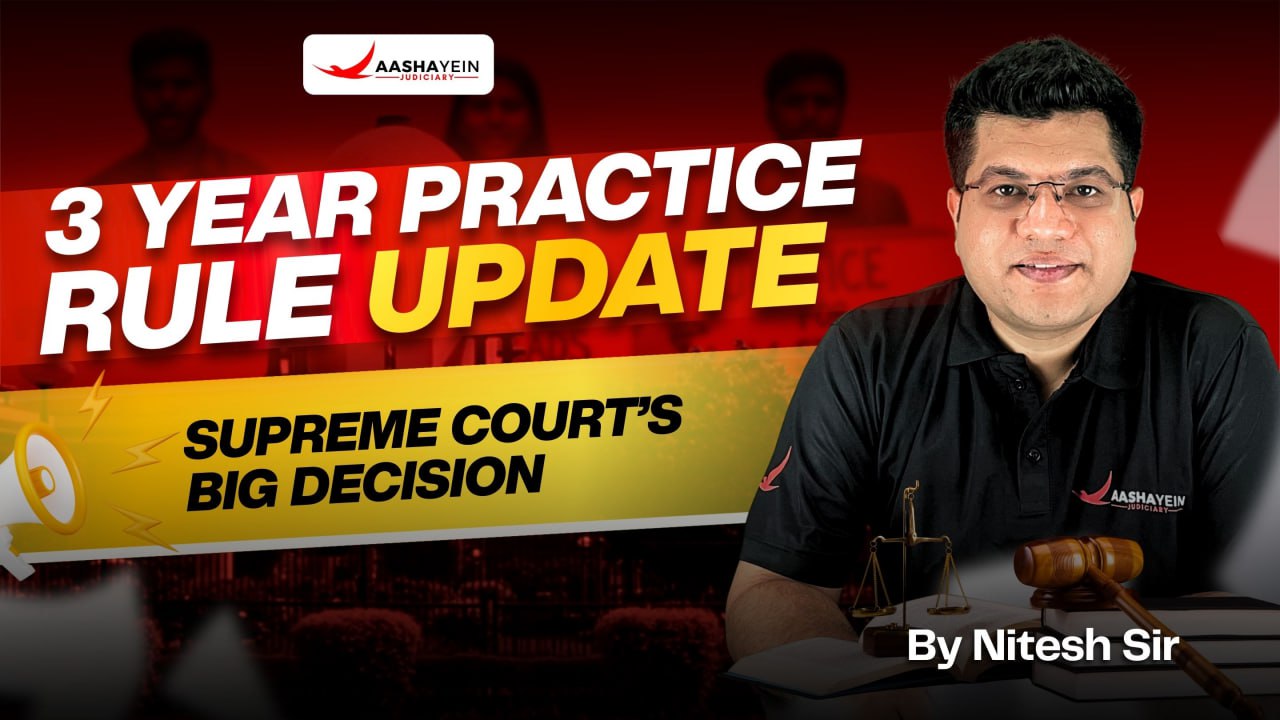
India's Supreme Court is weighing whether a mandatory practice period — reinstated in 2025 — should be relaxed for persons with disabilities. The answers from courts and law schools reveal a deeper fault line in how we think about judicial merit.
Case: All India Judges Association & Ors. v. Union of India & Ors.
Institutions Consulted: 10 High Courts · 21 Universities/Advocates
Based on compilation filed: 11.03.2026 | Amicus Curiae: Siddharth Bhatnagar
In May 2025, India's Supreme Court reversed a decade-old position and brought back a rule that had long divided the legal community: before you can sit in judgement, you must first spend three years as a lawyer. The reinstated three-year bar practice requirement for Civil Judge (Junior Division) recruitment sparked immediate debate — and in January 2026, the Court invited High Courts and law universities to address a narrower, but consequential, question: should this requirement be relaxed or waived for persons with disabilities?
The responses — from 10 High Courts and 21 institutions — are now compiled, and they expose a deeply contested debate about competence, inclusion, constitutional rights, and what it takes to be a good judge.
For judiciary aspirants, Aashayein Judiciary has also been actively discussing the implications of the three-year practice rule and how it affects future judicial service preparation.
At a Glance
|
Metric |
Figure |
Note |
|
High Courts consulted |
10 |
Ranging from full retention to complete dispensation |
|
Law schools & advocates |
21 |
Including NLSIU, RGNUL, CNLU, and senior advocates |
|
Judicial vacancies |
~4,800 |
Unfilled subordinate court positions nationally |
|
Against the rule |
72% |
Of 256 RGNUL stakeholder survey respondents |
The Rule and What It Means
The three-year practice requirement is simple on its face: to appear in the examination for Civil Judge (Junior Division), a candidate must have practised as an advocate for at least three years. The Supreme Court, in its May 2025 ruling, held that this direct courtroom exposure is essential to producing competent judicial officers.
Before that ruling, fresh law graduates could directly attempt the judicial services examination — a position the earlier third All India Judges Association judgment had permitted. The reinstatement was a pivot, and it immediately raised questions: who does this rule help, and who does it harm?
"A judge without practical bar experience faces formidable challenges in navigating the complex legal problems that come before courts. — University of Kashmir"
The PwD Question: Where the Debate Sharpens
The Supreme Court's January 2026 direction zeroed in on persons with disabilities. Courts — and much of India's physical infrastructure — remain deeply inaccessible. PwD lawyers often struggle to find senior advocates willing to mentor them. There is no organised facilitation. The question before the Court is whether these structural realities justify an exemption from the practice requirement.
The submissions split broadly into four camps:
|
Position |
Summary |
|
Full Retention (Majority) |
Delhi, Chhattisgarh, Gauhati, J&K, Karnataka, Odisha, Punjab & Haryana HCs. The rule is an eligibility condition and cannot be relaxed for any group without setting a dangerous precedent. |
|
Partial Relaxation (Middle path) |
Meghalaya HC, ILS Law College, SVKM Pravin Gandhi College. Acknowledge real barriers — propose reducing the period to 1–2 years plus age relaxation for PwDs. |
|
Structural Reform (Retain + fix) |
Karnataka HC, Senior Advocate Jayna Kothari, Centre for Rights of PwD. Keep the rule intact, but create PwD facilitation schemes under the RPwD Act, 2016. |
|
Abolish the Rule (Minority) |
Tripura HC, NLSIU Bengaluru, Chanakya NLU, KLE College, RGNUL Punjab. The rule lacks empirical justification and post-selection training is a superior alternative. |
The Sharpest Legal Argument: Eligibility vs. Suitability
The J&K and Ladakh High Court Committee articulated what may become the most legally significant distinction in this debate. Eligibility and suitability are fundamentally different: suitability — how well someone performs in a test — can be modulated and accommodated. Eligibility — whether someone is permitted to appear at all — is a harder bar. The three-year requirement, the Committee argued, is a condition of eligibility, and once that is accepted, it cannot be waived for any category of candidate.
This argument has a pointed implication: if PwDs are granted an exemption, SC/ST/OBC/EWS candidates — who also face structural disadvantages and must currently meet the same requirement — will have principled grounds to demand similar relief. The Delhi High Court's Rules Committee echoed this concern, warning against establishing a precedent of category-based eligibility carve-outs.
"Accepting infrastructural inadequacy as a ground for waiving an eligibility condition would open the door to similar demands from multiple categories of candidates. — J&K and Ladakh High Court Committee"
Watch the full detailed video on our YouTube channel: 3 Year Practice Rule Update | Latest Suggestions from High Courts & Law Schools | Nitesh Sir
The Empirical Challenge
Among the boldest submissions came from RGNUL Punjab, which did something unusual: it actually gathered data. Surveying 256 respondents — law students, advocates, judges, and legal professionals across 16 states — it found that approximately 72% opposed the mandatory three-year rule, with only 16% in support.
RGNUL's findings cut to the heart of the matter: a practice certificate can be obtained without sustained trial work. Three years of nominal enrollment is a poor proxy for genuine courtroom competence. Judicial training, the survey suggested, is inherently bench-oriented and is better developed through post-selection supervised environments than through the often-unstructured early years of junior advocacy.
Chanakya National Law University's Prof. Faizan Mustafa mounted a related challenge: the rule was reintroduced without collecting empirical data comparing the performance of judges recruited with and without the requirement. He urged the Court to put the rule in abeyance — at least for students who enrolled before the May 2025 ruling — until such evidence exists.
NLSIU Bengaluru went further, noting that the three-year rule has effectively defeated the institution's founding mission of producing graduates who move from quality legal education into judicial service. Institutional training, NLSIU argued, is a more reliable guarantor of competence than a pre-selection waiting period.
The Burden on the Vulnerable
KLE College of Law, Navi Mumbai, presented what might be called the proportionality case against the rule. In its current form, the three-year requirement hits hardest on precisely those who can least afford it: first-generation lawyers without professional networks, women facing social pressures around marriage and caregiving, economically weaker candidates who receive little or no stipend in their early practice years, and PwDs navigating inaccessible court buildings.
The rule also categorically excludes non-litigating lawyers — transactional lawyers, in-house counsel, legal researchers — despite their substantive legal competence. This is not a minor edge case; a significant share of law graduates pursue careers outside active litigation.
The Path Most Likely to Succeed
Cutting across ideological lines, the most widely supported approach is the structural reform route: retain the three-year rule in full, while directing High Courts through their Accessibility Committees — and Bar Associations, DLSAs, and state governments — to build robust facilitation mechanisms that give PwD lawyers a realistic shot at fulfilling the requirement.
This approach draws on Sections 19 and 23 of the Rights of Persons with Disabilities Act, 2016, which impose obligations on legal institutions to ensure accessibility and reasonable accommodation. Karnataka High Court and Senior Advocate Jayna Kothari both proposed making DLSA/SLSA empanelment of PwD lawyers count towards the practice period. The Centre for Rights of PwD proposed dedicated law clerk positions in subordinate courts as structured pathways into practical experience.
The appeal of this route is its constitutional elegance: it does not require the Supreme Court to revisit or soften its May 2025 ruling, does not open the door to eligibility relaxation across other categories, and takes the disability rights framework seriously as a mandate for structural change rather than a justification for symbolic exemptions.
Points of Near-Universal Agreement
Despite sharp divisions, three things united almost every submission: judicial competence is a non-negotiable public interest; the structural barriers PwDs face in accessing the legal profession are real and must be addressed; and any solution must withstand constitutional scrutiny under Articles 14, 16, and 21.
The live discussion before the Supreme Court will test whether the Court finds a way to honour all three — or whether it must choose between them.
Based on the analytical report compiled by Amicus Curiae Siddharth Bhatnagar, filed 11.03.2026, in W.P.(C) No. 1022 of 1989 before the Supreme Court of India. For academic and discussion purposes only.
If you are preparing for judiciary exams and want structured guidance, mentorship, or preparation support, you can register here:
Fill the form here: https://www.alec.co.in/enquiry-page
Students can also explore preparation resources and mentorship programs offered by Aashayein Judiciary, designed to help aspirants strengthen legal concepts and prepare effectively for judicial service exams.